
Understanding Switching Differential in a Differential Pressure Switch


A differential pressure switch is widely used in HVAC systems, air handling units, cleanrooms, industrial ventilation systems, and filter monitoring applications. It monitors the difference in pressure between two points and changes its electrical contact state when the pressure reaches a specified setpoint.
When selecting a differential pressure switch, two important specifications to understand are the adjustable pressure range and the switching differential. Although these parameters are related, they serve different purposes.
1. What Is the Pressure Range of a Differential Pressure Switch?
The pressure range indicates the minimum and maximum differential pressure settings that can be selected on the switch.
For example, consider a differential pressure switch with the following specification:
Adjustable pressure range: 500 Pa to 2500 Pa
Switching differential: 150 Pa
In this example, the switch can be adjusted to operate at a selected differential pressure between 500 Pa and 2500 Pa, subject to the manufacturer's specifications.
If the required switching pressure is 1500 Pa, the switch can be set to activate when the differential pressure reaches that value.
2. What Is Switching Differential?
The switching differential is the difference between the pressure at which the switch activates and the pressure at which it resets.
It is also commonly referred to as switching hysteresis or the differential between the switching points.
The switching differential prevents the switch from repeatedly changing its electrical state when the measured pressure fluctuates slightly around the setpoint.
Example: Pressure Switch With a 150 Pa Switching Differential
Assume the differential pressure switch is set to activate at 1500 Pa and has a switching differential of 150 Pa.
When the pressure rises, the switch activates at 1500 Pa. When the pressure subsequently decreases, the switch resets at approximately 1350 Pa.
The calculation is:
Reset pressure = Activation pressure − Switching differential
Reset pressure = 1500 Pa − 150 Pa = 1350 Pa
Therefore, the switch operates between two pressure thresholds:
1500 Pa: Switching point when pressure rises.
1350 Pa: Reset point when pressure falls.
This example assumes the switching differential is defined as the difference between the rising-pressure activation point and the falling-pressure reset point. Actual switching behavior depends on the manufacturer's specifications and the selected contact configuration.
3. Why Is Switching Differential Important?
Switching differential is important for reliable operation in applications where pressure fluctuates.
For example, in an HVAC system, the differential pressure across an air filter may change due to variations in airflow. If a pressure switch activates and resets at nearly the same pressure, small fluctuations can cause frequent switching.
A suitable switching differential helps to:
Reduce frequent ON/OFF switching.
Improve the stability of control signals.
Reduce unnecessary switching cycles of connected equipment.
Support reliable filter monitoring and ventilation control.
4. Difference Between Pressure Range and Switching Differential
Parameter | Meaning | Example |
Adjustable pressure range | The range within which the switching setpoint can be selected | 500–2500 Pa |
Switching differential | The pressure difference between activation and reset | 150 Pa |
Activation pressure | The pressure at which the switch changes state as pressure rises | 1500 Pa |
Reset pressure | The pressure at which the switch returns to its original state as pressure falls | 1350 Pa |
5. Applications of Differential Pressure Switches
Differential pressure switches are commonly used in:
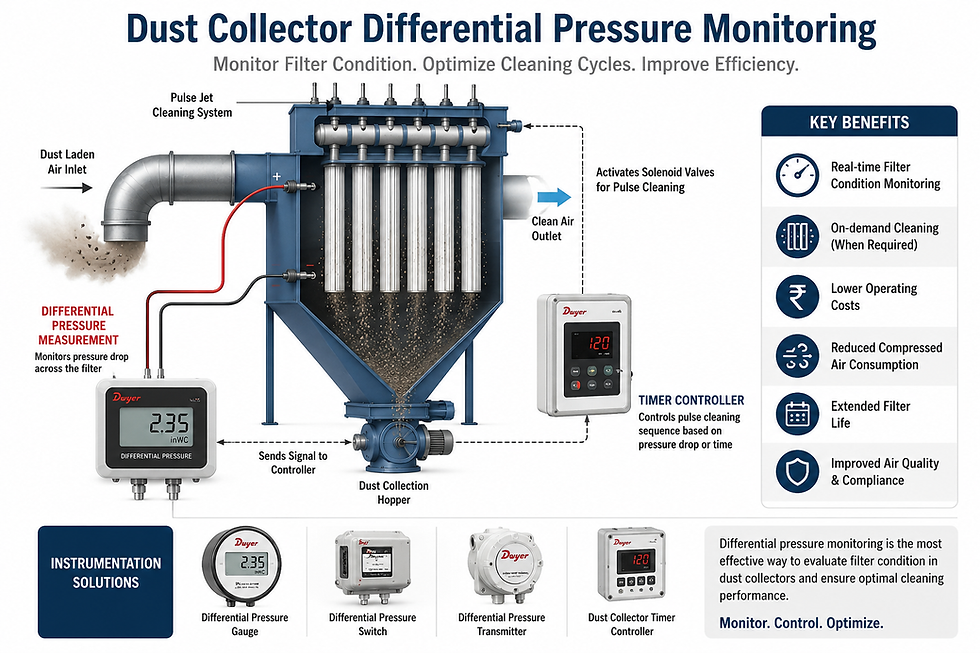
Air filter monitoring: Detecting when a filter reaches a specified differential pressure.
HVAC systems: Monitoring airflow and pressure conditions in air handling units.
Cleanrooms: Monitoring differential pressure between rooms or controlled areas.
Industrial ventilation: Providing pressure-based control or alarm signals.
Duct systems: Monitoring pressure differences across components.
The appropriate pressure range and switching differential should be selected based on the application's operating conditions and required control accuracy.
When selecting a differential pressure switch, it is important to distinguish between its adjustable pressure range and its switching differential.
For a switch with a range of 500–2500 Pa and a switching differential of 150 Pa, the setpoint can be adjusted within the specified range, while the switching differential determines the separation between the activation and reset pressures.
Understanding both specifications helps engineers select the correct switch for reliable pressure monitoring and control.
Need help selecting a differential pressure switch for your application? Contact Trias Automation for assistance with differential pressure measurement and switching solutions for HVAC and industrial applications.


Comments