
How Differential Pressure Monitoring Improves Dust Collector Performance

Industrial dust collection systems play a critical role in maintaining air quality, protecting equipment, and ensuring workplace safety. However, one of the most common challenges faced by plant operators is determining when dust collector filters require cleaning or replacement.
Instead of relying on fixed maintenance schedules, modern dust collection systems can monitor filter conditions in real time using differential pressure measurement. This approach not only improves system efficiency but also reduces maintenance costs and extends filter life.
Why Filter Monitoring Matters
As dust accumulates on filter cartridges or filter bags, the resistance to airflow increases. This resistance is measured as differential pressure across the filter.
A gradual increase in differential pressure indicates that:
Dust is accumulating on the filter media.
Airflow efficiency is decreasing.
The filter cleaning cycle may be required.
Excessive pressure drop can affect process performance and energy consumption.
By continuously monitoring the pressure drop across the filter, maintenance teams can make informed decisions rather than performing unnecessary filter cleaning or replacement.
How Differential Pressure Monitoring Works
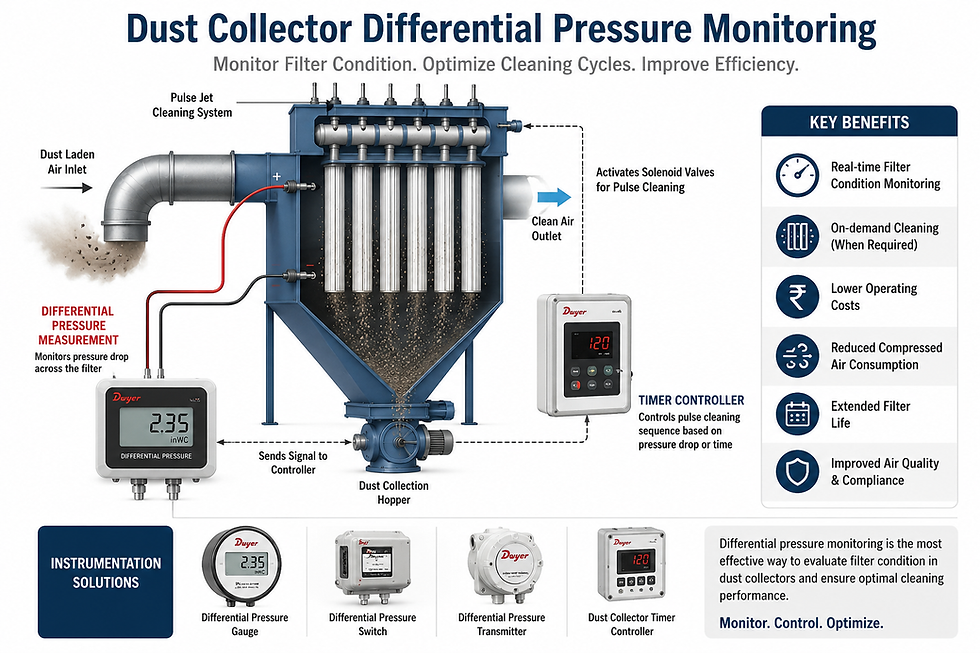
A differential pressure gauge or transmitter is installed across the dust collector filter. The instrument measures the pressure difference between the clean air side and the dirty air side of the filter.
When the filter is clean, the pressure drop remains low. As dust builds up, the differential pressure increases. Once it reaches a predefined limit, the cleaning system can be activated either manually or automatically.
This simple measurement provides valuable insight into the actual condition of the filter without interrupting plant operations.
Dust Collector Cleaning Cycle
Many pulse-jet dust collectors use compressed air to clean the filters. The cleaning sequence typically includes:
Monitoring the differential pressure across the filters.
Detecting when the pressure drop exceeds the acceptable limit.
Activating the timer controller.
Sequentially energizing solenoid valves.
Releasing compressed air pulses into the filters.
Dislodging accumulated dust into the collection hopper.
Returning the filter to normal operating conditions.
This process ensures that filters are cleaned only when required, reducing compressed air consumption and increasing filter life.
Benefits of On-Demand Filter Cleaning
Implementing differential pressure-based filter monitoring offers several advantages:
Improved dust collector efficiency.
Reduced maintenance downtime.
Longer filter service life.
Lower compressed air consumption.
Reduced operating costs.
Better process reliability.
Real-time filter condition indication.
Improved workplace safety and air quality.
On-demand cleaning systems are particularly beneficial in industries where dust generation varies throughout production cycles.
Applications
Differential pressure monitoring in dust collectors is commonly used in:
Cement plants
Pharmaceutical manufacturing
Food processing industries
Metal fabrication facilities
Woodworking industries
Chemical processing plants
Powder handling systems
HVAC filtration systems
Industrial manufacturing plants
Selecting the Right Instrumentation
Depending on the application requirements, the following instruments can be used:
Differential Pressure Gauges for local indication.
Differential Pressure Switches for alarm and cleaning cycle activation.
Differential Pressure Transmitters for PLC or BMS integration.
Dust Collector Timer Controllers for pulse cleaning sequence control.
Digital controllers for automated on-demand cleaning applications.
The combination of pressure monitoring and intelligent cleaning control significantly improves dust collector performance while minimizing operational costs.
Conclusion
Differential pressure monitoring is one of the most effective methods for evaluating the health of dust collector filters. By measuring filter pressure drop and initiating cleaning only when necessary, industries can improve energy efficiency, reduce maintenance expenses, and maximize the performance of their dust collection systems.
Investing in the right monitoring and control solution ensures cleaner air, longer filter life, and reliable plant operation.


Comments